Tuesday, March 19, 2013

What a Difference a Year Makes! (and other musings)


It’s been a couple of weeks already since my last post. Where does the time go? Speaking of time, what a difference a year makes! Last year we were spoiled, and as is often the case with being spoiled there were some major consequences, at least as far as crops and gardens were concerned.

March 20, 2012
Last year on St. Patrick’s Day it was 80 degrees here, the buds were all popping, and some fruit trees were even starting to flower. It all sounded great, but then April got much colder, and all those tender young buds and fruit tree flowers that excitedly rose early to greet the March summer got zapped by the April frost.

The consequences for fruit crops were dire. Harvests of cherries, peaches, apples, plums, and berries were decimated. Fruit prices were much higher, and many of the “cool” kinds of heirloom apples and pears that we enjoy wandering the countryside to find in the fall were either full of frost damage or not available at all.

This spring (much colder and more consistent) is really what you want as a gardener and as someone who wants to pick peaches and cherries this summer! As I type this some of the perennial herbs are just starting to show some signs of life under a cover of fresh snow. While the early warm weather last year was a nice treat, this is much better for the crops, and isn’t that what matters most?
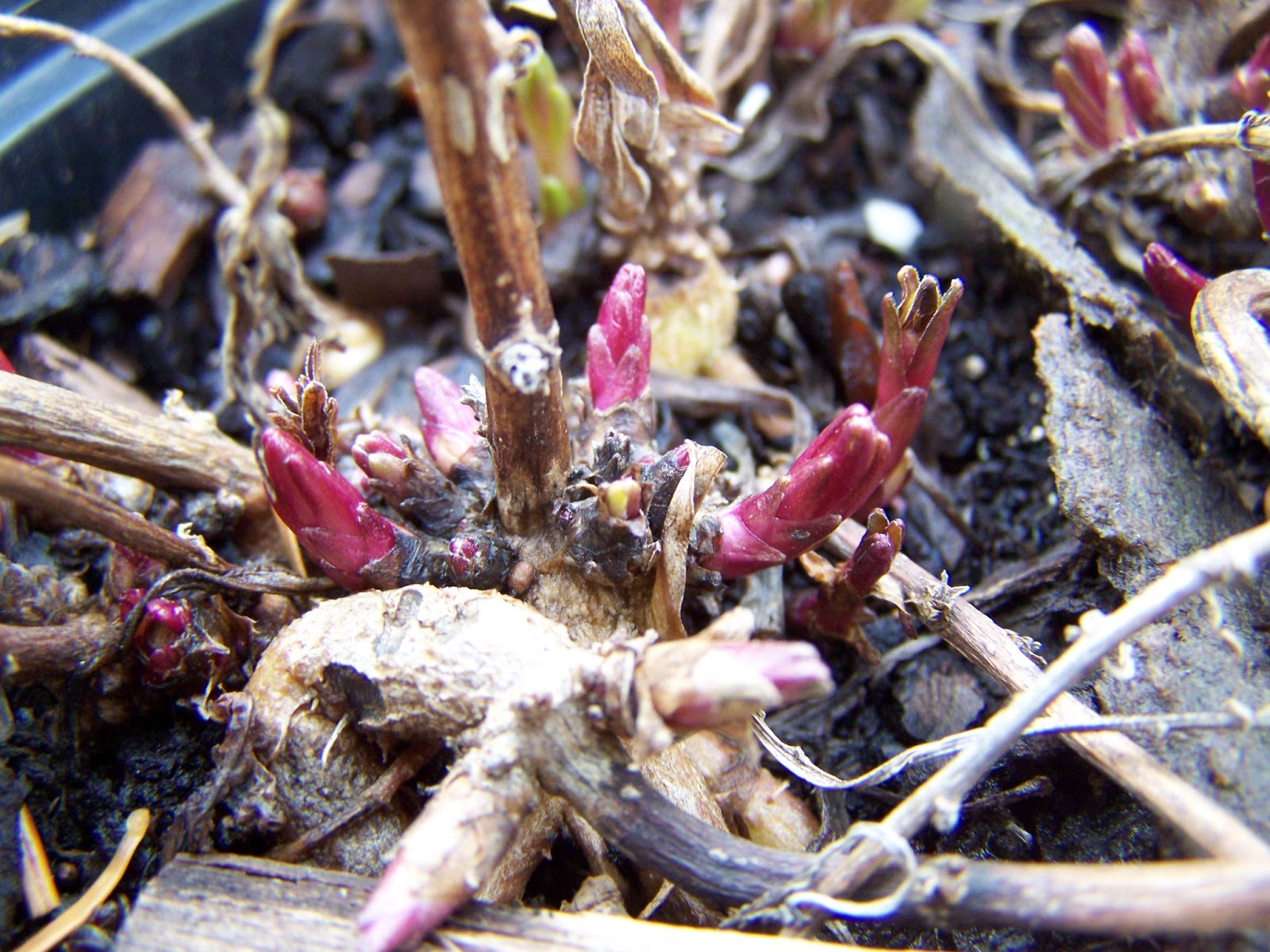
Tarragon sprouts outside on the porch
On the subject of perennial herbs, it turns out tarragon is perennial here. I’ve never grown it before, but I kept all of lat year’s herb containers outside all winter just for the heck of it. The thyme always comes back, but we also have oregano popping up, and these pretty tarragon sprouts! And to think, I have a bunch of tarragon starting from seed inside! I guess I’ll have to figure out what to do with the extra.

Oregano sprouting outside
Most of the seedlings are up now, and we are finally getting some peppers! Last year the eggplant was the last crop to sprout, and I had started to wonder if we were ever going to see it. This year the eggplant preceded the peppers by a solid week, and so far we only have one lonely Anaheim chili and one California wonder sprouting. That’s a solid month after they were planted. It has been a lot colder this year, which is probably the reason the peppers have been slow to germinate.

The first pepper: Anaheim chili!
 One last note on peppers. I bought a poblano pepper from the store last week and grilled it up to put on a grilled vegetable sandwich, and I immediately decided I needed to add them to the garden. The issue is that it is March 19th already, so if they take a month to germinate I’ll have one inch tall plants in May. To get around this I’m going to try to cheat a bit and force them to germinate early. More on that in my next post (hopefully in a day or two)!
Lots of herbs!

Monday, March 4, 2013

Zucchini and Melons in Containers


As the calendar flips to March we’re ever closer to warmer days and sunny afternoons in the garden! Since I’ve received a few questions on the topic, I thought I would take a few minutes to discuss my thoughts on growing squash and melons in containers.

This plant was just starting out... They get BIG!
 In terms of container size, I would go with at least a 5 gallon container, but that would be the bare minimum. Zucchini (and any squash really) gets huge and needs space to stretch out. Our plant last year was about 3 feet wide and a good 2-3 feet tall. It’s one thing to read that, but once you have a monster plant taking over your patio it’s quite another! Unlike tomatoes, peppers, eggplants, or even something like Okra, squash needs a lot of horizontal space. This can make it tough to fit into a patio garden, since you can squish a couple of tomato plants together (since they grow mostly up) but that is harder to do with something like zucchini.

These containers are the perfect size for many crops
This year I am going to use the square 6.5 gallon containers I bought from Home Depot and just plant one zucchini plant in each (one yellow and one green). As I’ve learned over the past couple years of doing this, you will get more (and bigger) fruit from one healthy properly spaced plant than two or three crowded (and consequently smaller) plants.

In terms of yield, a couple of plants should suffice. Zucchini plants are famous for being heavy yielders, and one plant will often produce several squash a week. In the height of the summer squash season you can pick three and six will take their place! As you can see, the plant we had was ramping up nicely with squash until the powdery mildew got it. This is probably the biggest threat (at least where we are in Western New York) and every year it rolls in like a plague, leaving dead cucumbers, melons, and squash, not to mention broken dreams, in its wake (squash, cucumbers, and melons are all related, and easily pass maladies back and forth in a small garden). I have read about a number of treatments for powdery mildew, but from what I’ve gathered the treatments are preventative in nature, not curative. But that’s another post!

These 12 gallon bins might even be a bit small for the melons...
That brings me to the bush sugar baby melons, which will be an experiment for us this year. I plan on using a flexible 12 gallon tub and planting a “hill” of 2-3 plants in the middle. What I’ve found is that the limiting factor in container size is often moisture content of the soil: the smaller the planter the more stress on the plant due to lack of moisture. Consider that the fruit of a watermelon is saturated with water, and it becomes clear that these are going to need a good amount of soil from which to draw that water.

According to the seed packet, these melons are space savers due to their bushy plants (rather than vines) but something tells me they are going to get pretty big, so I’m going to use the biggest container I have and give them a corner of the porch to themselves. Whereas the other plants are relatively easy to move (I brought the entire garden of huge tomato plants inside during an extremely strong wind/thunderstorm last summer) something like a melon with 5-7 pound fruits would be difficult to move without damaging the fruit and/or plant. The key will be to find a place that it can stay undisturbed for the entire season.

Lots of herbs sprouting!
 In order to give the melons a head start, I’m going to start them inside in a couple of weeks. Speaking of the seedlings, we’re getting more and more on the seed table!

A cumin seedling!
 
Until next time, happy gardening!

Tuesday, February 26, 2013

First Tomatoes to Sprout!

It's a cold, windy, rainy night here, but inside on the seeding table things are starting to get interesting!

The Roma tomatoes have made an appearance!
Broccoli was the first crop up, and now it has company! Thyme gets the honors for first herb of the season, and the Roma tomatoes just popped up today to take the first tomato honors.

Thyme sprouts!

One of the best parts of starting plants from seed is that after a week or so there's something new almost every day. What will tomorrow bring?

Sunday, February 24, 2013

What to Grow in Containers?


Every year, I try to grow something different in addition to our old favorites. This year, my goal has been to make the garden as functional as possible. As hard as it is to believe given the seedling table, this meant that some things just didn’t make the cut.

Most notably, this is the first year I won’t be growing any okra. It is a pretty plant, grows well, and seems to love the heat of the porch. However, the trouble with okra is that we never seem to get enough at any one time to make a meal of it. It produces fairly consistently, but only 5-6 pods at any given time. I considered growing more, but then we would have 3-4 containers of okra on the porch when the crop has only limited uses (compared to another neat type of tomato, for example!).

There's always room for another tomato...
 The same thing applies to potatoes. They were very easy, a lot of fun, and produced. However, we got about 2 pounds of red potatoes in exchange for having a massive plant taking up the space of two tomatoes. If we had more space I would definitely grow them again, but we only have our upstairs porch to use, so they didn’t make the cut.

I also decided to plant a garden that more accurately reflects what we like to eat. Sounds basic, but when you’re in a seed aisle at the nursery and want one of everything, it can be tough to prioritize. This year we’re growing a wide variety of cooking greens, since we eat them a lot and they grow very well in containers. We’re also growing fewer bell peppers and for the first time I’m growing some hot peppers as well.

On the subject of the cooking greens, I plan on trying some crop rotation with them. I’ll start off by planting some collards and broccoli rabe in April. Once that bolts (or we harvest it all), I’ll plant some rainbow chard and kale in the same pots. I also have a 3rd container set aside for some Tuscan kale (which is amazing if you like kale). My hope is to have cooking greens growing from April to late October or so via succession plantings.

I started this rosemary plant from seed last year and it's still going strong!
Finally, I am planting a ton of herbs, with the goal of having a massive harvest to dry. Last year I tried drying my herbs with a dehydrator for the first time, and I was amazed! After about 5-6 hours of drying most herbs were ready for bottling in spice jars. Basil took a bit longer due to its water content. At first I carefully removed each basil leaf from the plant and stacked them nicely onto the circular trays. Later, I cut the braches off at ground level and put the entire plants inside the trays. It turns out that once the leaves dry they flake right off the stems, saving time and fuss. We’re still using our marjoram, sage, and purple basil from the garden, and it’s better than any store bought herb. Plus, it saves a lot of money if you cook with a lot of herbs. Last year I thought of the herbs as primarily a fresh harvest, but this time around I’m looking to plant as many as I can fit on the porch in between all the vegetables. 

Space saver.... We shall see!
One of this year’s most exciting new crops for us is the bush sugar baby melon from Burpee. It says it can be grown in containers on the package, and apparently stays fairly compact but still produces 8-10 pound fruits. We probably don’t really have the room for a large melon plant, but then again, there is always room for one more container!

Saturday, February 23, 2013

New, Improved Seedling Table


It’s a gloomy, grey, wet Saturday here in our neck of the woods, but spring days are right around the corner! I’ve spent the last few days improving on last year’s seeding table and then seeding most of the crops for this year’s garden. Here are some of the improvements/key features:

1) Wooden cage: I built a better “cage” over the table. If you recall lat year’s setup (you can take a look under the tab above) I ended up not using most of the vertical space on my wooden risers. This time around, I wanted greater flexibility with my t5 fixture (which does not have a chain because it is designed to sit on top of a fish tank) and greater stability. This was achieved by building a basic box and then screwing it into the top of the table (an old picnic style table). We protected the table using a folded plastic shower curtain, which is a cheap and simple way to keep water from seeping into the wood. Best of all, the lumber was just spare boards I had laying around. Who said it had to look overly fancy!

Between the chain and the shelf I built to hold the aquarium fixture, the lights can easily be lowered or raised from just a few inches above the seedlings to about 3 feet above them. Right now the light is about 9 inches from the cells.

View of the seedling table setup
2) Tinfoil baking pans. We use the dollar store tinfoil cake pans ($1 for a 2 pack) and place the peat moss cells on top. This has two advantages. First, it makes moving the trays to water or rotate for even lighting very easy. Second, you can water the seedlings by pouring the water into the tray. The cells will soak up the water as needed, keeping the soil inside moist and your seedlings happy. One other feature is that you can fit 12 of the large peat cells onto one sheet, or 24 of the smaller ones. It’s like they were made to order!

Plastic shower curtain and tinfoil trays
 3) Lighting: I bought one dual fluorescent fixture at Home Depot for about $10 and fitted it with the GE plant grow bulbs (about $5 each at the hardware store). These bulbs have a spectrum more conducive to plant growth than a typical fluorescent bulb (you’ll notice they appear redder in color than most fluorescents).

In addition, I have a dual t5ho aquarium light fixture for growing plants. Turns out it grows terrestrial plants just as well as aquatic ones! By itself it is probably enough light, but paired with the other fixture I can get consistent coverage over the entire table. Plus, the aquarium bulbs I use are each a different color temperature (one more bluish, one more like typical sunlight) giving a fuller spectrum. They are also very bright, as they are t5ho.

One final advantage is that the table is located in a well lit room with windows on all sides. This easily doubles the light the table receives, and in the morning the sun directly shines on it (when we get sun).

If I didn’t have the aquarium fixture, I would just buy two dual fluorescent fixtures. The first time I ever started seeds inside I just had the fluorescent one and a bright room, and it worked fine.

4) The box fan: This is a new addition. I have the lights on one timer. They come on at 7:00am and go off at 10:00pm. I also set a box fan at the end of the table on a TV tray, and set it up with its own timer to come on for 15 minutes at a time at random intervals during the day. This soft breeze will help the seedlings to develop stronger stems in preparation for our windy porch. It also seems to stimulate plant growth. I’m looking forward to seeing how much difference this makes in comparison to last year, when I didn’t use one.

Broccoli is the first crop to sprout for 2013!
 That’s a brief overview of the new table setup. As you can see, things are already starting to sprout! Before you know it we’ll be slicing a Black Krim, still warm from the summer sun….

Saturday, February 2, 2013

How many tomatoes, peppers, eggplants, or cucumbers per container? Here are the results!

87 peppers, 653 tomatoes (including cherry), 36 eggplants, 25 cucumbers (in a disease shortened season), and much more! That's quite a haul for a porch garden!

It's been an incredibly busy few months, so I've taken a break from blogging about the garden. However, part of the reason I started this blog was to get some data out there for would be container gardeners as to what one could expect in terms of yield given a specific planting scenario.

It was a pretty good year overall. Sadly my cucumbers were killed early on by powdery mildew (aka the bane of my gardening existence year after year)! Aside from tomatoes, cucumbers are probably my favorite garden crop, as they are so versatile and tasty. This year I am looking into mildew resistant varieties (look for a post to come on that soon).

Keeping track of all the harvest numbers was a great experience in terms of planning for future gardens as well. We have a roughly 24x8 upper porch, and we were able to get quite a bit of harvest this year. However, there were many inefficiencies (such as packing a Brandywine and Evergreen tomato plant into one pot and getting very little out of them). This year I am looking to plant just enough of each crop that we have it all year, with minimal extra. Except for tomatoes, that is! I can't help myself there!

Without further ado, here are the results: 


Crop Type and Variety

Potting Setup
Yield (does not include any fruits lost to disease or damage)
Notes
Peppers
Bell Pepper (Carnival Mix and California Wonder)


4 plants per square 6.5 gallon container
33
Good yield, seems to take to crowding well, 20% crop loss due to blossom end rot
Banana Sweet Pepper
7 plants in a long 7 gallon window planter
54
Very high yielding plants… these just keep producing!

Tomatoes


Tomatoes
Sweet 100 Cherry Tomato
2 plants in a 7 gallon container
185
Excellent flavor, continuous production right up to frost
Jellybean Grape Tomato
2 plants in a 6 gallon container
58
Good flavor, moderate yield in this growing condition, 20% loss due to high winds knocking immature fruit from plant
Yellow Pear Tomato


3 plants in a 12 gallon flexible plastic tub
255
Extremely high yield, mediocre flavor with mealy texture
Green Zebra Tomato
2 plants in a 12 gallon flexible plastic tub
61
High yielding plants with large clusters of fruit, amazing flavor when picked yellow, 25-30% loss due to blossom end rot early in season
Black Krim
2 plants in a 12 gallon flexible plastic tub
43
Great flavor and texture, good yield, 20% loss due to blossom end rot
Brandywine
1 plant in a 12 gallon flexible plastic tub (with one Evergreen tomato plant)
7
Incredible flavor (best of the garden this year) but not high yielding. Could have been crowded.
Evergreen Tomato
1 plant in a 12 gallon flexible plastic tub (with one Brandywine tomato plant)


5
Great flavor (sweeter than Green Zebra), low yield
Tomatillos (Giant)
2 plants in a square 6.5 gallon container
39
Healthy plants, good yield, but I will stick to the smaller tomatillos for container gardens
Eggplant
Round White Eggplant
2 plants in a square 6.5 gallon container
18
Very good yield in likely crowded plants, excellent flavor and texture, last batch of fruits in early fall turned yellow when ripe and were inedible due to bitterness
Black Beauty Eggplant


1 plant in a square 6.5 gallon container with 1 round white and 1 long eggplant)
4
Amazing that we got anything from this highly crowded plant.  Yielded 4 very large (approx. 1.5 pound) eggplants! Great flavor and texture.


Long Purple Eggplant


1 plant in a square 6.5 gallon container with 1 round white and 1 long Black Beauty)
14
Good yield, also very crowded. Seems perfect for a container. Very pretty plant.
Okra
Red Okra (Burgundy)
4 plants in one 6.5 gallon square container
37 pods
Attractive plants, very large and healthy, but not high yielding enough at any one time.
Green Okra (Clemson Spineless)
4 plants in one 6.5 gallon square container
21 pods
Attractive plants, very large and healthy, but not high yielding enough at any one time.
Cucumber
Straight 8 Cucumber


7 plants in one 12 gallon flexible tub (w/ 3 Lemon Cucumber plants)
11
Delicious and  high yielding, but plant with dozens of immature fruits was killed by powdery mildew in late July
Lemon Cucumber
3 plants in one 12 gallon flexible tub (w/ 7 straight 8 plants)
14
Another very high yielding plant, good flavor, pick before they turn too dark yellow or they will be tough. Also killed by powdery mildew in late July.
Miscellaneous Crops
Rainbow Swiss Chard
5 plants in one 6.5 gallon square container
5 large meals
Delicious, highly productive cooking green well suited to containers. Leave the center leaves when you cut and it will continue to grow back until it bolts in late summer. Then, plant again in same container for a fall crop, as it likes the cool weather.
Red Potatoes
3 plants in 7 gallon nursery pot
About 2 pounds
A fun experiment, and delicious flavor, but they take up a lot of room for the yield.
Detroit Red Beets
Various small planters
6 medium sized beets
These were planted in very small containers as they became available, good flavor, would be well suited to dedicated containers for a better yield.
Zucchini
1 plant in a 6.5 gallon square container
1
Delicious fruit, enormous plant (so plan on it needing some space) but killed by powdery mildew soon after it bloomed.
Broccoli (major hybrid)
3 plants in a 6.5 gallon square container
3 large crowns
Delicate, sweet, and tender flavor. Not a great yield to space invested ratio, as the crowns don’t grow back (you do get smaller side shoots though)